

Pull the trigger with confidence.We look deeper into market trends. Our analysis puts our readers ahead of price movements... and ahead of the public. For over 40 years, institutional investors and individual traders have relied on our forecasts. Get the edge you've been missing. |
|
Steepening Yield Curve Good For Small Caps

Now that the Fed has cut short term rates several times, we are seeing a further steepening of the yield curve. It is tough to portray the entirety of changes in the whole yield curve over time, and so I am summarizing it in this week's chart by showing just the spread between 10-year and 3-month Treasury yields.
The 10y-3m spread does a really cool trick, which this week's chart illustrates. Changes in that 10y-3m spread draw us a roadmap for what small cap outperformance or... Read More
QQQ Volume Spike is a Bottom Marker

When technical analysts learn about volume, they are taught that it is useful for helping to confirm (or not) what prices are doing. This includes hopefully seeing expanding volume to confirm a price breakout. And a head and shoulders structure should ideally have the heaviest volume on the left shoulder or the head.
For big ETFs like QQQ, it works differently. As a gross generalization, QQQ volume works as a fairly pure inverse sentiment indication. High volume is a sign of a bottoming... Read More
A-D Line New High Limits Drawdowns

We have just seen a new all-time high in the NYSE's daily Advance-Decline (A-D) Line. It confirms the new highs in the major indices, and that is a really good thing.
Years ago, I undertook a study to see what it means to have a new high in the A-D Line. In order to increase my sample size, I specified that it had to be just a new 3-year high instead of all time, and then I looked at what the max drawdown was in the SP500 over the succeeding 3 months. The recent decades' results are... Read More
Seasonality and the January Dip

We are still in the "best 6 months of the year", due to last until early May 2026, and so the current uptrend ought to continue. But we should also expect a meaningful dip this month, based on the DJIA's Annual Seasonal Pattern (ASP) shown in this week's chart.
I created this ASP by chopping up the daily data into 1-year chunks, restating their value for each year to a starting value of 1.00, then averaging them together as the percentage change from that starting value rather than the... Read More
UMich Consumer Confidence is Low, Which is Bullish

The University of Michigan has been conducting its "Survey Of Consumers" since 1955. The recent data have been among the lowest of their published readings, meaning that survey respondents are not feeling all that great about the supposed 4.3% rate of US GDP growth. Perhaps people are more attuned to indications like manufacturing employment being in a decline since May 2024. And thus far, the low gasoline prices have not gotten any traction in the hearts of consumers.
Lows in consumer... Read More
Cass Trucking Data Negative

Back in September I reported on how the data on US trucking from Cass Information Systems was not looking good for the stock market. Since then the message has gotten a little bit worse, as seen in this week's chart.
Cass tracks trucking data in a lot of different ways, and publishes their own indices. This week's chart shows the 12-month percentage changes in their Shipments and Expenditures indices. Both measure trucking activity, but in different ways. And what is important for our... Read More
Gold’s Stair-Step Pattern

Gold prices are making a repeating stair-step pattern of movements as gold trends higher. Each part of this sequence sees a multi-month up move after breaking out to higher highs, then another multi-month consolidation of those gains. Right now gold is in a consolidation phase.
This week's chart shows our Proportional Price Oscillator, which is a variation on the classic McClellan Price Oscillator. The Price Oscillator which my parents developed back in 1969 is similar to the McClellan... Read More
Decennial Pattern

Years ending in 5 are up years almost without exception through the entire history of the DJIA. The two exceptions were 2005, when the DJIA fell 0.6%, and 2015 with a 2.2% drop. Thus far in 2025, the stock market is back to its normal year 5 behavior, with a 12.5% gain through Dec. 4, 2025. It would have to be a really bad rest of the month to spoil this year 5's record.
This week's chart shows the Decennial Pattern for the DJIA, created by chopping the price history up into 10-year... Read More
Download Latest Reports
(Subscription Required)
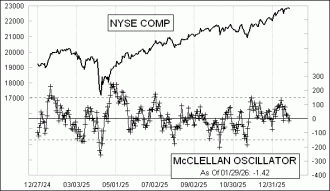
 Daily Edition - Thursday, January 29th
The McClellan Oscillator
 Created 1969, the McClellan Oscillator is recognized by technical analysts as the essential tool for measuring acceleration in the stock market. Using advance-decline statistics, it gives overbought and oversold indications, divergences, and measurements of the power of a move.
Free Chart In Focus Email
Our Work in the News
- Foundation for the Study of Cycles - Technical Analysis Masterclass with Sherman McClellan | Cycles TV March 15, 2025
- Market Misbehavior - The Origin Story of the McClellan Oscillator
- CNBC - Here’s Why Gold is a Leading Indicator for Oil
- Wealthion - Adam Taggart Interviews Tom - Part 2
- Wealthion - Adam Taggart Interview’s Tom - Part 1
Latest Articles
 The McClellan Oscillator & Summation Index
- Useful Analysis Links
- The Origin Story of the McClellan Oscillator
- The Intersection of Stock Market & Political Races
- Fox Business Appearance
- Tom on CNBC
- 20 Years Publishing This Newsletter
- Tom on Apple’s Massive Market Cap
- Hindenburg Omen Chart for Dec. 4 CNBC Interview
- Could market see September selloff?