

Pull the trigger with confidence.We look deeper into market trends. Our analysis puts our readers ahead of price movements... and ahead of the public. For over 40 years, institutional investors and individual traders have relied on our forecasts. Get the edge you've been missing. |
|
Treasury-Bund Spread Rising Is Bullish

A year ago I noted here that there was a divergence in effect between stock prices and the Treasury-Bund spread. That divergence has since been rehabilitated, and the spread is now rising which is a bullish condition.
The Treasury-Bund spread I am referring to is the difference between the current 10-year yield on US T-Notes versus the equivalent 10-year German sovereign debt instrument. Ever since German reunification in October 1990, there has been a very strong correlation between this... Read More
7-Year Cycle in Margin Debt

The total amount of margin debt has been screaming higher, a factor which has drawn a lot of attention. High margin debt has been present at major market price tops in the past. But there is more to this relationship than just the overbought indication.
Lars Von Thienen of the Foundation for the Study of Cycles recently filmed a great video, available at www.youtube.com/watch?v=lic-00cjI40, where he looks at the cycles implications of these data. He used cycle analysis software to detect... Read More
Crude Oil and Yields Diverging

Crude oil prices have been in an amazingly strong positive correlation with bond yields for a few decades. But it is not a perfect correlation, and there can be information in the subtle differences.
It makes sense that oil prices and bond yields should move together. Higher oil prices mean higher prices generally, and inflation is the enemy of any fixed income product, stealing away the value of the future payments. So it is not a surprise to see them moving together.
What is... Read More
RASI Shows Depth of Correction

The Ratio-Adjusted Summation Index (RASI) for the NYSE is down to -522 and still falling. This is low enough to mark a decent end point for an ordinary market correction. Yes, it can go lower than this, especially in a determined bear market. But a low reading like this in a long term uptrend is a nice thing to see.
When my parents first created the McClellan Oscillator in 1969, they were initially looking at just the individual exponential moving averages (EMAs) of the daily... Read More
Cass Trucking Data Shift Positive

There has just been an improvement in the US trucking fleet data, according to the folks at Cass Information Systems, and it has bullish implications for the stock market.
Cass publishes data each month on several categories of trucking data. The chart above shows the 12-month rate of change (12ROC) for the Cass Freight Shipments and Expenditures Indices. When both of these are positive, it carries a strong positive message for the stock market. If both are negative, that carries a big... Read More
Gold Says Oil Prices Going Higher For Longer

I covered here in June 2026 how the upturn in oil prices was on time, but the magnitude was overly amplified by the war with Iran. Now oil prices are starting upward again after a pullback, and this is going to be a much longer uptrend. That is the message of gold's 20-month leading indication shown in this week's chart.
This is a relationship I discovered years ago, when looking at gold and oil prices on a long term chart. I was not using the time offset then, but when I tilted my head... Read More
Bitcoin COT Report Data Work Differently

I have been following several different futures contracts in the weekly Commitment of Traders (COT) Report since 2001. Bitcoin futures came along in December 2017, and were featured in the COT Report starting in April 2018. So the history is not as deep as a lot of the other futures contracts I track. One point which became clear early on is that the COT data for Bitcoin futures work differently than other contracts.
I prefer the original format data, which breaks down traders into... Read More
Sunspots and the Yield Curve

The yield curve has been steepening ever since its maximum point of "inversion" back in June 2023. That is good news for the economy that the yield curve is steepening, as that serves as a healthy sign for GDP. The term "steepening" refers to yields at the long term end of the maturity spectrum being higher than short term yields. So steepening can occur by raising long term rates, lowering short term ones, or some combination of the two.
A climax point for this steepening trend is due... Read More
Download Latest Reports
(Subscription Required)
 Daily Edition - Monday, October 26th
The McClellan Oscillator
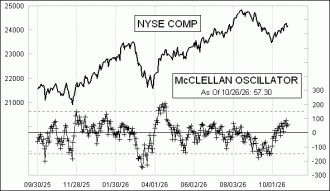
 Created 1969, the McClellan Oscillator is recognized by technical analysts as the essential tool for measuring acceleration in the stock market. Using advance-decline statistics, it gives overbought and oversold indications, divergences, and measurements of the power of a move.
Free Chart In Focus Email
Our Work in the News
- Foundation for the Study of Cycles - Sunspots & Markets with Tom McClellan | Market Cycles Report Mar. 16, 2026
- Foundation for the Study of Cycles - Technical Analysis Masterclass with Sherman McClellan | Cycles TV March 15, 2025
- Market Misbehavior - The Origin Story of the McClellan Oscillator
- CNBC - Here’s Why Gold is a Leading Indicator for Oil
- Wealthion - Adam Taggart Interviews Tom - Part 2
Latest Articles
 The McClellan Oscillator & Summation Index
- Useful Analysis Links
- The Origin Story of the McClellan Oscillator
- The Intersection of Stock Market & Political Races
- Fox Business Appearance
- Tom on CNBC
- 20 Years Publishing This Newsletter
- Tom on Apple’s Massive Market Cap
- Hindenburg Omen Chart for Dec. 4 CNBC Interview
- Could market see September selloff?